
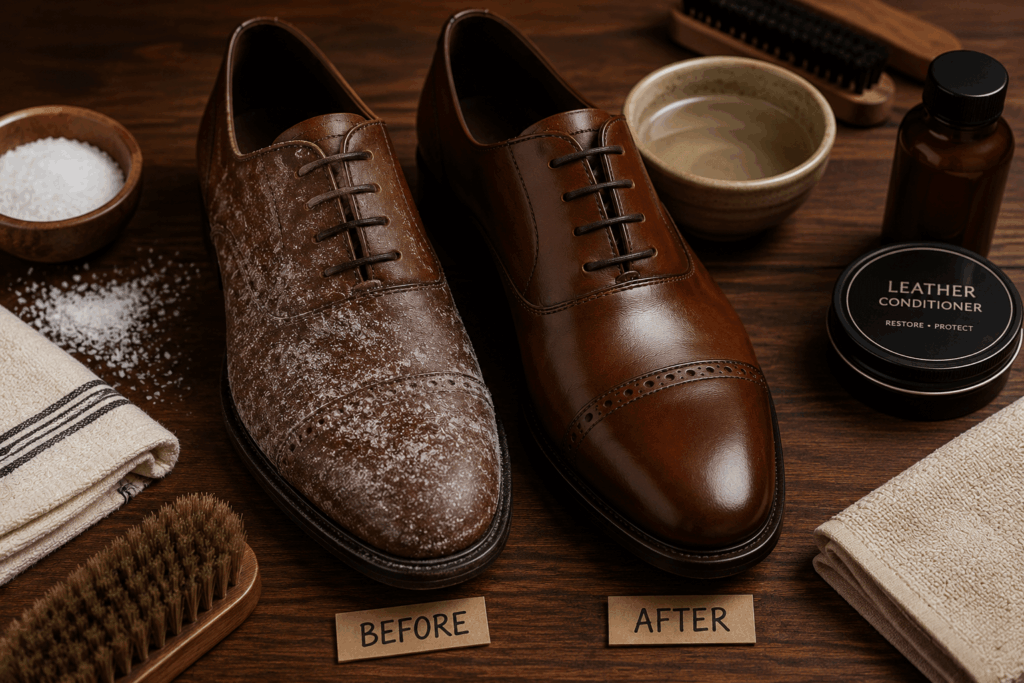
How to Remove Salt Stains from Leather Shoes
By Lerato, Founder of Ribbons Collection
If you’ve walked through rain or a damp pavement in South Africa, you’ve probably seen it — a pale, chalky mark creeping up the leather near the sole. That’s a salt stain, and it’s one of the most common issues genuine leather shoes face in our climate. The good news: it’s easy to fix if you catch it early and treat it properly.
Why Salt Stains Happen
Salt stains form when water containing dissolved salts and minerals soaks into the leather and then evaporates, leaving the salt crystals behind on the surface. This is especially common after walking through rain, puddles, or damp pavements, and it tends to show up as light, powdery marks near the edges and sole of the shoe.
How to Remove Salt Stains (Step-by-Step)
- Let the shoes dry completely first. Never try to treat a stain while the leather is still wet — work only once the shoes have fully air-dried at room temperature.
- Mix a mild solution. Combine equal parts water and white vinegar in a small bowl.
- Dampen a soft cloth with the solution — it should be damp, not wet.
- Gently wipe the stained area, working from the edge of the stain inward to avoid spreading it further.
- Wipe again with a clean, damp cloth (water only) to remove any residue from the vinegar solution.
- Let the shoes air-dry naturally away from direct heat.
- Condition once fully dry, using a neutral leather conditioner to restore moisture and shine to the treated area.
Preventing Salt Stains Before They Start
- Avoid deep puddles and standing water where possible — most salt staining happens from repeated exposure, not a single light shower.
- Wipe shoes down after rainy days, even if no stain is visible yet, to remove salts before they have a chance to set in.
- Apply a protective leather cream regularly (see our full leather care guide) — well-conditioned leather is naturally more resistant to staining.
- Let wet shoes dry slowly at room temperature, stuffed with paper to hold their shape — never force-dry near a heater, which can set stains permanently and crack the leather.
Frequently Asked Questions
What causes white marks on leather shoes after rain? Those are salt stains, caused by dissolved salts and minerals in rainwater or puddle water that are left behind on the leather surface as it dries.
Can I use vinegar on all types of leather? A diluted water-and-vinegar solution is generally safe for genuine leather, but always test on a small, hidden area first, and use it sparingly rather than saturating the leather.
How do I stop salt stains from coming back? Regular conditioning helps, since well-moisturised leather absorbs less water and salt. Wiping shoes down after rain, before stains fully set, also helps prevent them from recurring.
Can old, set-in salt stains still be removed? Older stains may take a couple of gentle treatments to fully lift, but the same vinegar-and-water method still works — just be patient and avoid over-wetting the leather in one session.